Loading Screen V2

Building Capacity for Sustainable Agroforestry

At Good Forest Indonesia, we believe that long-term restoration depends on strong community capacity. This reflects our principle that restoring forests is not only about planting trees, but also about empowering the people who care for and protect them.

Through capacity-building activities, Good Forest Indonesia continues to strengthen the knowledge of field staff and farmers by equipping them with a deeper understanding and stronger skills in cultivating agroforestry commodities such as jengkol, petai, and cocoa.


Building Capacity Through Knowledge Exchange

Field staff play an important role in supporting farmers throughout their restoration journey. As the primary bridge between Good Forest Indonesia and local farmers, strengthening their technical capacity is essential to ensure that the support provided in the field is grounded in the right knowledge and can be effectively applied.

Between April and July 2026, Good Forest Indonesia conducted capacity-building activities for field staff to strengthen their understanding of jengkol, petai, and cocoa cultivation. These activities were carried out through two different learning programs: the Training of Trainers (ToT) Beans, which involved experts from Universitas Gadjah Mada (UGM), and a cocoa cultivation training through a learning visit to the Mars Cocoa Academy in South Sulawesi, Indonesia.

Beyond field staff, we also invited selected farmers to participate in the Cocoa Cultivation Training. These farmers were selected based on their potential to independently share and disseminate the knowledge they gained within their villages. Through this approach, capacity building does not stop with field staff, but also equips farmers with knowledge and skills that they can pass on to other local farmers in their communities.


Training of Trainers (ToT) on Jengkol and Petai Cultivation

Jengkol and petai are among the commodities included in Good Forest Indonesia’s tree-planting program. Both commodities are cultivated using an agroforestry approach to improve soil fertility while providing farmers with an alternative source of medium-term income.

Through this training, field staff gained a deeper understanding of crop cultivation and management techniques. They also learned about land condition analysis, planting pattern strategies, stages of agroforestry development, as well as the characteristics and cultivation requirements of jengkol and petai.

“For me personally, the ToT Beans was not only an opportunity to expand my knowledge of jengkol and petai cultivation, but also an important foundation for carrying out my role as a Field Project Officer more effectively. The training strengthened my understanding of cultivation techniques, land management, and agroforestry approaches that can be adapted to farmers’ conditions.” Ferri Fernando, Field Project Officer at GFI.

For this training, Good Forest Indonesia engaged Ratih Madya Septiana, an expert with extensive practical experience and expertise in jengkol and petai cultivation. In addition to delivering the training, Ms. Ratih also supported the development of a structured learning curriculum that can be shared with farmers.

Through this process, Good Forest Indonesia aims not only to strengthen the technical capacity of field staff, but also to equip them with structured learning tools and guidelines to support farmers and facilitate farmer groups more effectively.


Cocoa Cultivation Training at Mars Cocoa Academy, South Sulawesi

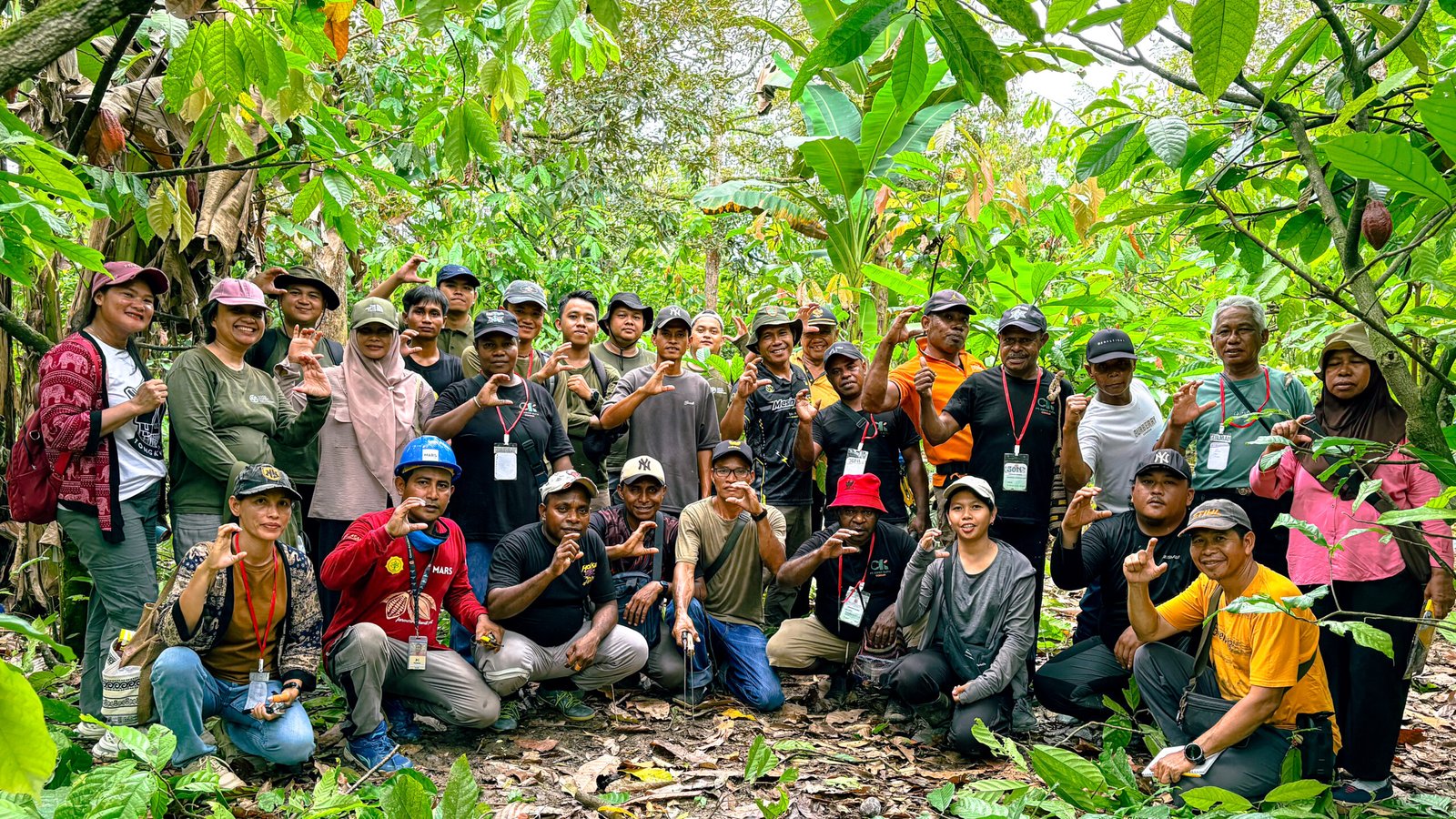
The training aimed to broaden participants’ knowledge of cocoa cultivation through a learning visit to the Mars Cocoa Academy in South Sulawesi, Indonesia. Mars Cocoa Academy is a cocoa training center that aims to improve cocoa productivity and cultivation quality through technical training and business development for farmers and agricultural extension workers.

Through the learning visit, staff and farmers received both theoretical and practical training in cocoa cultivation. Participants also had the opportunity to gain first-hand exposure to cocoa cultivation technologies and practices that are not yet widely accessible to local farmers.


Training Towards Sustainable Impact

We believe that capacity building does not end when a training program is completed. Meaningful impact begins when knowledge is applied, shared, and continues to grow within communities. For Good Forest Indonesia’s field team, the knowledge gained through these learning opportunities will support them in providing better assistance to farmers and strengthening the implementation of sustainable agroforestry practices.

For farmers who participated in the training at Mars Cocoa Academy, the program was not only about improving their cultivation skills, but also about building their confidence to independently manage and care for their farms. In turn, this confidence can create a multiplier effect within their communities, enabling them to apply and share the knowledge they have gained with other farmers around them.

“I would like to express my sincere gratitude to Good Forest Indonesia (GFI) for facilitating my participation in the training at MARS Academy. I gained a lot of valuable knowledge throughout the training, which has greatly motivated me to develop various innovations on my farm in the future, particularly to build a sustainable farm, both in terms of crop production and economic value. I hope that through GFI’s guidance and continued support, I can apply the knowledge I have gained and create something beneficial not only for myself, but also for the people around me, especially the community in my village.” — Prianto, Cocoa Farmer

Every lesson learned, every skill developed, and every farmer empowered contributes to a larger vision: creating healthier landscapes supported by communities with the knowledge and confidence to protect and restore their environment.

Because sustainable forests do not grow only from the trees we plant, but also from the knowledge we nurture.

Scroll to Top